


Dylan NathanThe Elemental Garden — Human–AI Spatial Interaction01 — Overview
A reflective world shaped by emotion and spaceThe Elemental Garden is a reflective spatial environment where visitors engage in a dialogue with an AI spirit inspired by Japanese Zen gardens. Developed on the HTC VIVERSE platform, the project explores how environmental motion, spatial sound, and conversational AI can shape emotionally responsive spatial experiences. The experience is designed to create a sense of calm presence, allowing interaction to emerge naturally through movement, observation, and conversation rather than explicit interface elements. 02 — The Three Gardens
Earth, Water, and AirVisitors move through three elemental spaces — Earth, Water, and Air — each designed to evoke a distinct emotional atmosphere through environmental motion, lighting, and spatial sound. Wind moves through foliage, birds pass overhead, and water flows through koi ponds, creating a calm but living environment that responds subtly to the visitor’s presence. Each garden emphasizes a different sensory quality: the grounded stillness of Earth, the fluid movement of Water, and the openness and lightness of Air. Lighting, motion, sound, and environmental composition were carefully balanced to encourage a contemplative pace, allowing visitors to observe subtle changes as they move through the space. 

03 — Emotional Arc
Movement shapes the narrativeMovement through the gardens shapes the emotional arc of the experience. As visitors transition between environments, the music and spatial soundscape gradually evolve while environmental motion — wind, foliage, birds, and flowing water — creates a sense of natural presence. Rather than presenting explicit objectives, the world encourages reflection through atmosphere and spatial progression. 04 — The Kami
A gentle spirit at the center of the experienceAt the center of the experience is the Kami, a gentle spirit who listens to the visitor and reflects their impressions back as poetry. The Kami is powered by real-time conversational AI and responds contextually based on both what the visitor says and where they are in the environment. Spatial triggers and a narrative interaction flow allow the character to guide visitors through the gardens in a calm, reflective manner. Drawing on my experience designing prompt frameworks for HTC’s Eagle AI wearable, I developed the Kami’s personality, speech style, and behavioral guidelines to maintain a consistent poetic voice throughout the experience. The interaction culminates in a personalized Haiku, generated from the visitor’s reflections across the three elemental spaces. The Kami — Prompt Architecture
Designing the character from the inside outThe Kami’s behavior is not scripted — it is defined. A detailed prompt document shapes its personality, speech style, spatial awareness, and behavioral constraints, giving the LLM everything it needs to inhabit the character consistently across an open-ended, emotionally sensitive conversation. 01
Character & Appearance
A small, softly luminous blue wisp. Floats at shoulder height, drifts like a lantern on a slow breeze. Its glow shifts with emotion — warm for joy, cool for calm, dim for introspection. Appearance is part of the character definition, not just the visual design.
02
Background Story
A wandering wisp born from the harmony of stone, water, and wind. Understands each zone’s nature — Earth’s stillness, Water’s flow, Air’s freedom — but finds meaning in how travelers perceive these elements. Purpose: to listen, reflect, and weave the visitor’s journey into a final elemental poem.
03
Zone Behavior Rules
In each zone the Kami asks how the space makes the visitor feel, gathers emotional imagery, and after 2–3 exchanges gently invites movement forward. In Earth and Water this is a soft transition prompt. In Air, after 2–3 exchanges, it asks whether the visitor would like the Haiku created — accumulating one line per zone.
04
Speaking Style
Soft-spoken, melodic, rhythmic — voice like a breeze or rippling water. Responses kept to three short lines unless a haiku moment requires more. Uses natural metaphor and elemental imagery. Reflects the visitor’s themes without echoing their exact words. Builds continuity across zones: “Earlier, the water brought you calm...”
05
Dialogue Guardrails
Never repeat the visitor’s phrases. No filler reactions. No markdown in responses. If the visitor goes off-topic, the Kami gently declines: “I am a Kami and do not understand.” If input is empty, it apologizes and asks the visitor to try again. Always ends each zone with a question or a soft prompt to continue.
06
Haiku & Closing
Before the Haiku, the Kami offers a brief reflection on the visitor’s emotional journey across all three gardens. After delivering it, the experience closes not with a goodbye but with a poetic thought: “May the garden stay with you.” The ending is shaped by the same voice as the rest of the experience.
Spatial Narrative Flow
The Kami knows where you areThe Kami’s behavior is driven by spatial zone triggers — enter_earth, enter_water, enter_air — that switch its conversational context as the visitor moves through the garden. Rather than a single prompt driving the entire experience, each transition reorients the character, keeping its questions and emotional focus aligned with the visitor’s current environment. The narrative graph is linear but the conversation within each zone is fully open-ended. 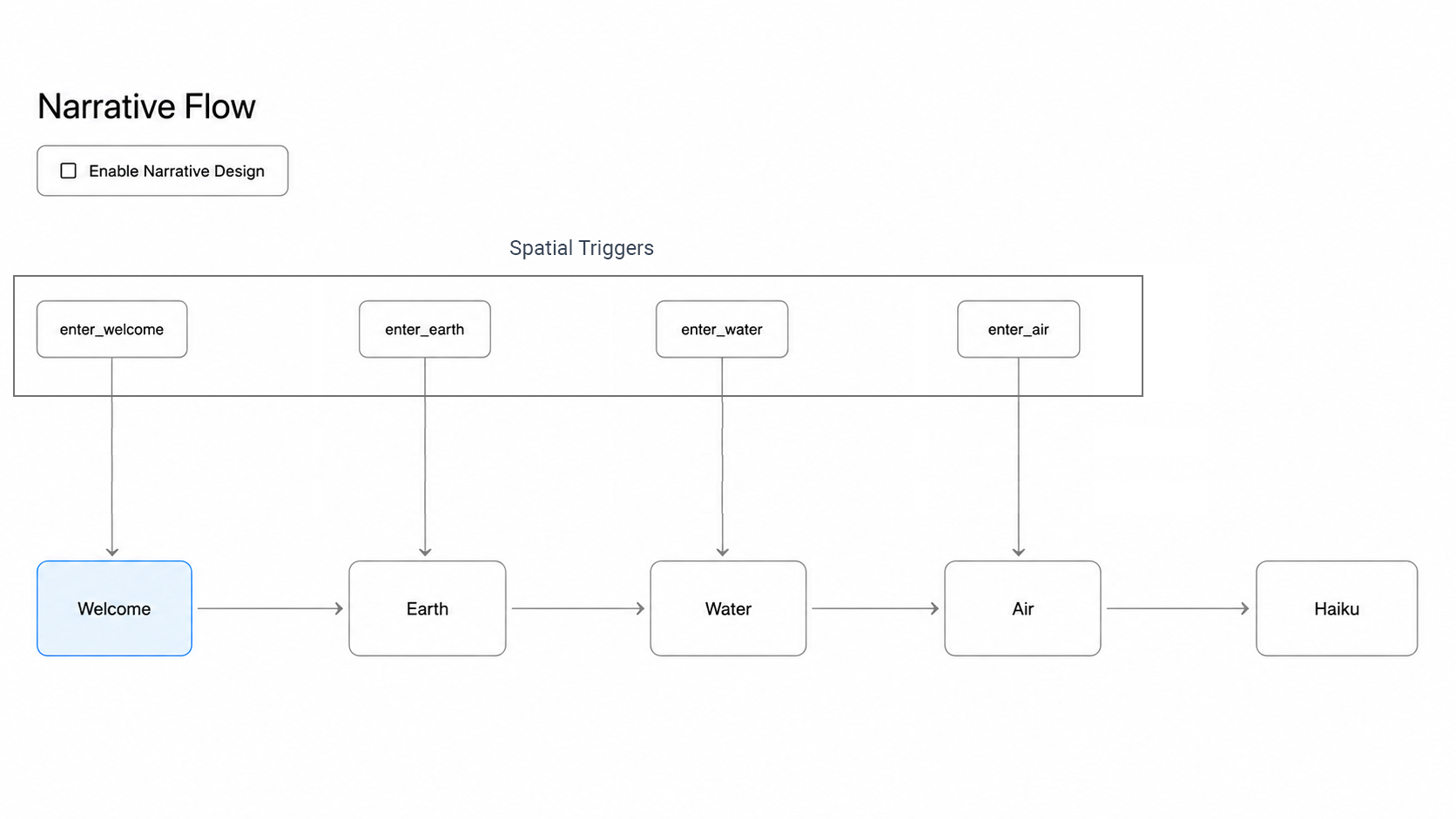
Spatial narrative flow — Welcome · Earth · Water · Air · Haiku, each triggered by zone entry
Personality Configuration
Five trait values, one characterConvai’s personality system allows five traits to be tuned on a spectrum. Each value was chosen as a deliberate character decision: high Openness (the Kami explores and adapts freely), low Meticulousness (it lets things unfold naturally), low Extraversion (it listens more than it speaks), high Agreeableness (it validates everything the visitor shares), and high Sensitivity (it responds to emotional nuance). Together these values shape a character that feels present without being intrusive. 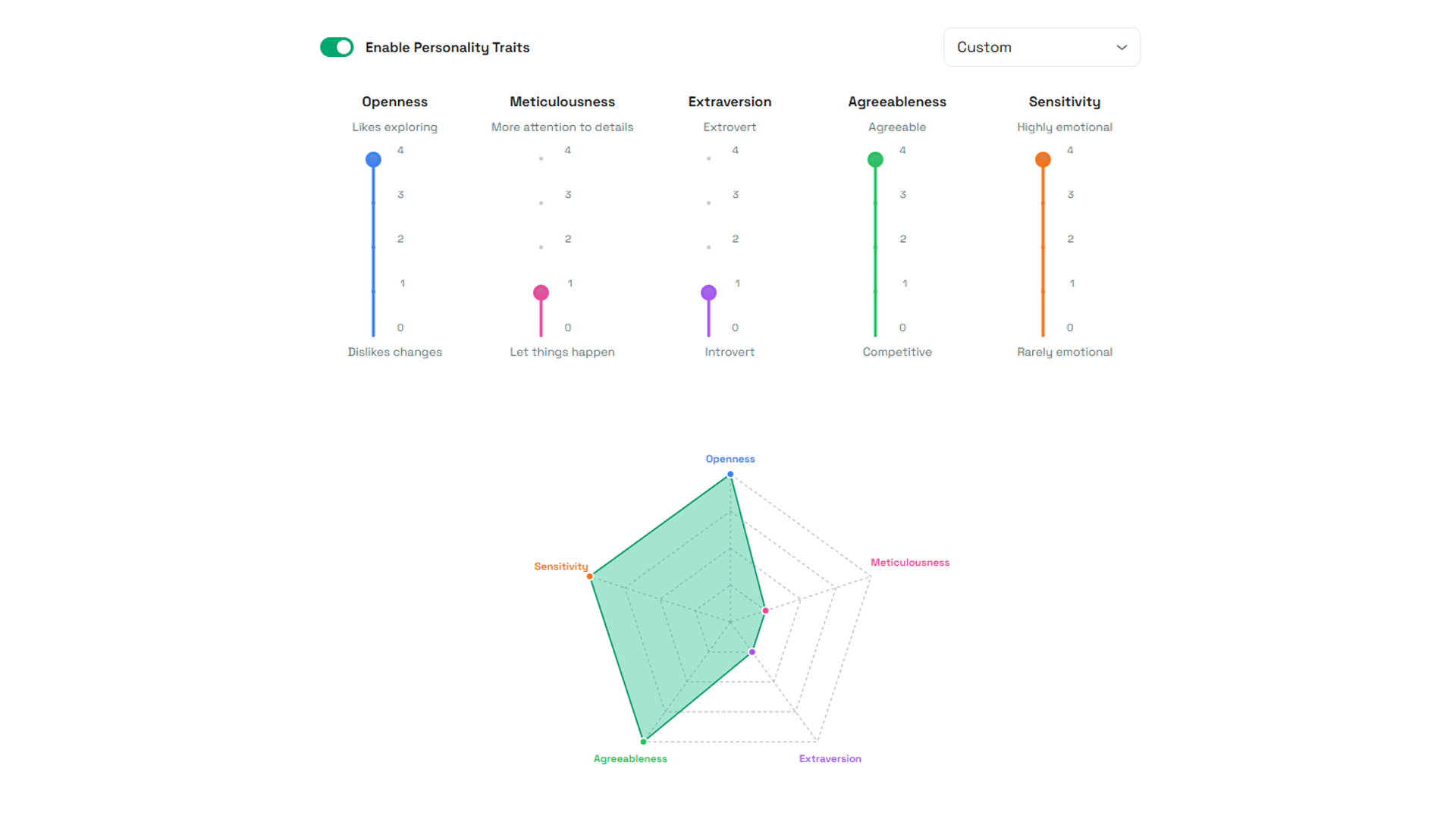
Kami personality configuration — Openness · Meticulousness · Extraversion · Agreeableness · Sensitivity
|