


Dylan NathanMagic Leap — Tokyo Olympics Pavilion01 — Overview
A 5,000 sq ft multiplayer experience bringing location-based AR to a mass audience at the world's largest cultural stageDeveloped for the Tokyo Olympics, this was a large-scale multiplayer mixed reality installation spanning 2,000 sq ft of interactive play space within an 5,000 sq ft total footprint. Designed to onboard groups of first-time AR users into a shared, competitive experience set across nine Tokyo neighborhoods, it combined spatial computing, environmental storytelling, commissioned music, and physical set design into a single cohesive world. The physical set was manufactured in Japan by the studio behind Ultraman and Godzilla, built to my specification and shipped to the US for development and testing. 
Early concept — skateboard and climbing AR experience, new events making their Olympic debut
02 — The Concept
From Olympic sport to Tokyo cityscapeThe original concept centered on skateboarding and sport climbing — two events making their Olympic debut in Tokyo — with the physical set featuring backlit walls evoking a Tokyo cityscape at night. As the project evolved, the experience expanded into a full exploration of Tokyo itself: nine distinct neighborhoods, each with its own visual identity, spatial soundscape, and atmosphere. The visual direction drew from the neon-drenched, holographic aesthetic of classic anime — Akira, Ghost in the Shell — and from my earlier holographic UI work, reimagining the city as a layered mixed reality environment where digital and physical space coexist. 
Developed concept — Tokyo buildings with illuminated windows, holographic elements floating throughout the space
03 — The Experience
Nine neighborhoods, two teams, one cityThe experience was structured as a team-based competition across nine Tokyo neighborhoods: Shibuya, Shinjuku, Harajuku, Akihabara, Tsukiji Fish Market, the Olympic Stadium, the Imperial Palace, Asakusa and Senso-ji Temple, and Roppongi. Two teams moved through the space simultaneously, each purchasing upgrades from the neighborhoods using a limited shared budget via a holographic cart interface. Each neighborhood had its own original musical theme, composed and produced by a Los Angeles music studio working under my creative direction, blending spatially as users moved between zones to create a continuous, location-aware soundscape. Teams could identify each other through holographic masks overlaid on each player, color-coded by team. Live capture through the Magic Leap headset — Tokyo neighborhoods, holographic environments, and the gamified collection experience
Holographic cart UI interaction — motion design and spatial sound design
04 — Visual Systems
Masks, scoreboards, and holographic identityTo allow players to distinguish between teammates and competitors in a shared AR space, each user was assigned a holographic mask overlaid on their face — visible to all other headset wearers. Team color and mask design made team membership legible at a glance without requiring explicit UI. At the center of the arena, a large floating holographic scoreboard tracked team progress, its design drawn from the same holographic visual language as the environments — a spatial object that felt native to the world rather than imposed on it. 
Holographic team masks — visible to all players in the shared AR space

Floating holographic scoreboard and leaderboard at the center of the arena
05 — The Physical Set
Built to specification, designed for ARThe physical set was manufactured by the renowned Japanese studio behind Ultraman and Godzilla, built to my specification in Japan and shipped to the US for AR development and testing. Lighting was a critical design consideration — indirect and neighborhood-color-coded, bright enough to ensure user safety and support Magic Leap One's tracking cameras, while not competing with or washing out the AR overlay. The layout was designed to allow intuitive navigation between neighborhoods and to fully accommodate wheelchair access throughout the play space. 
Lighting design — indirect neighborhood-color lighting designed to support AR tracking without competing with the digital overlay

Lighting design — indirect neighborhood-color lighting designed to support AR tracking without competing with the digital overlay
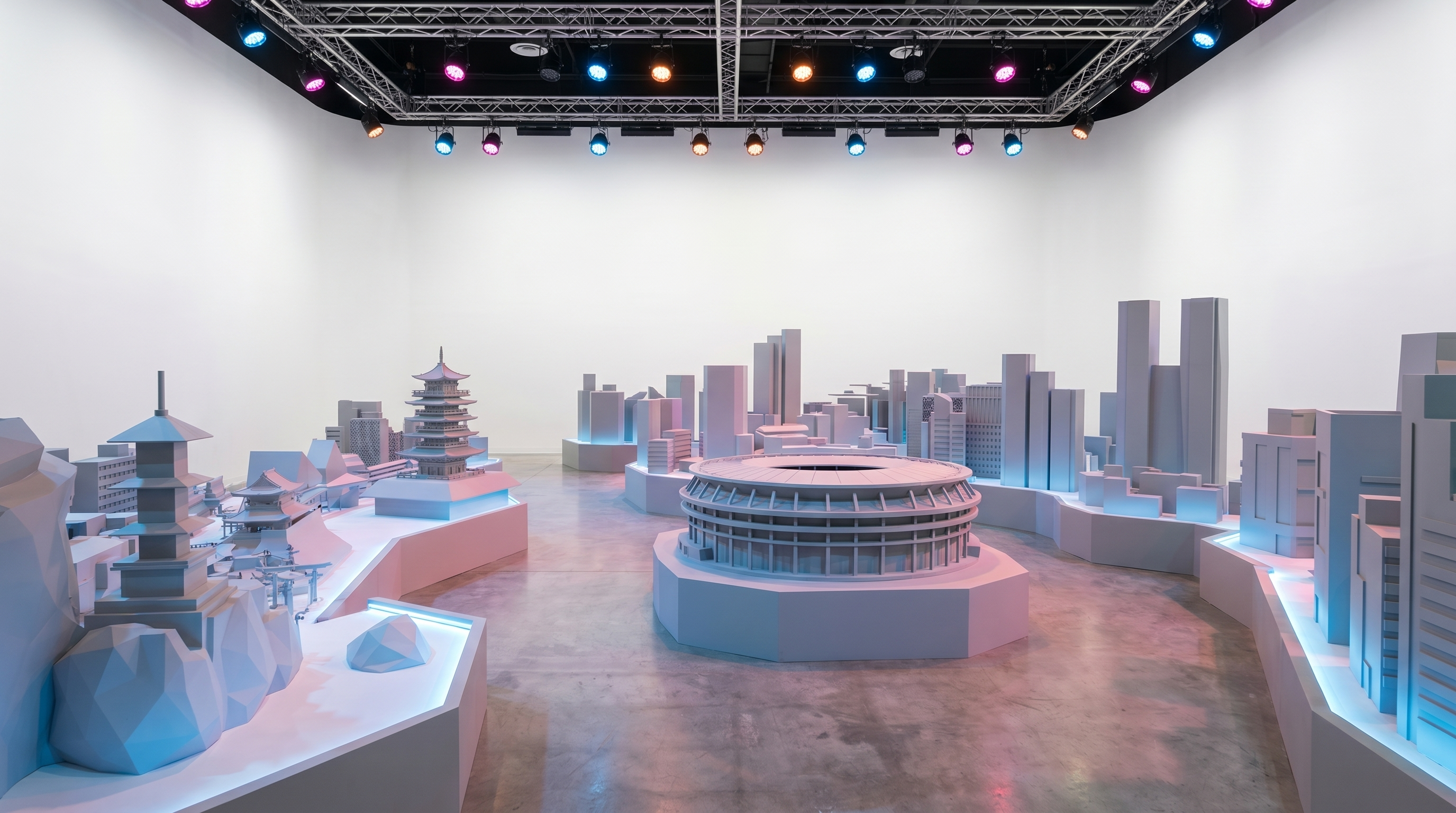
The physical set and lighting — Models were built in Japan by the Ultraman studio
|